

Buying a car or SUV is a significant financial commitment, and protecting that investment with the right insurance is an important part of vehicle ownership. While both cars and SUVs fall under four-wheeler insurance, many owners wonder whether the insurance coverage differs between the two.
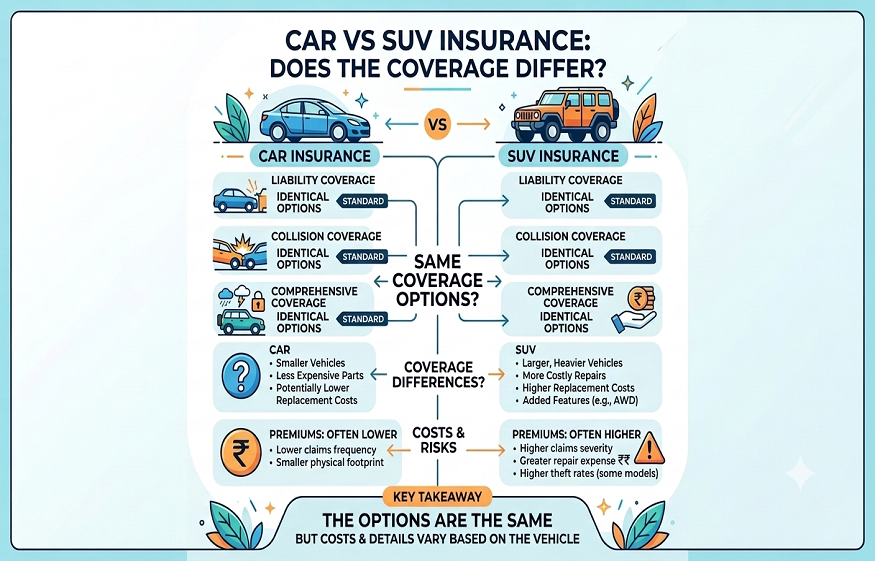
The short answer is that the basic types of car insurance coverage are broadly similar, but the premium, Insured Declared Value (IDV), repair costs, add-ons and risk factors can differ depending on the vehicle.
Whether you own a compact hatchback, sedan or SUV, understanding how insurance works can help you select suitable protection rather than choosing a policy based only on its premium.
Is Car Insurance Different for an SUV?
The fundamental insurance options available for cars and SUVs are generally similar. Vehicle owners can choose third-party insurance, which is mandatory for vehicles driven on public roads in India, or opt for broader own-damage or comprehensive coverage.
Third-party insurance covers eligible liabilities arising from injury, death or property damage caused to another person. However, it generally does not cover damage to your own vehicle.
Comprehensive four-wheeler insurance combines third-party liability protection with own-damage coverage for specified risks. Depending on the policy, this may include protection against accidents, theft, fire, natural calamities and certain man-made events.
Therefore, an SUV does not necessarily require a completely different type of insurance. Instead, the vehicle-specific factors can influence the premium and appropriate level of coverage.
Why Can SUV Insurance Cost More?
SUVs can have higher purchase prices and, in many cases, higher repair or replacement costs than smaller cars. Their larger body panels, specialised components, powerful engines and higher-value parts can affect the cost of repairing damage.
The premium can also be influenced by factors such as:
- Vehicle’s make and model
- Engine capacity
- Age of the vehicle
- Insured Declared Value
- Registration location
- Claim history
- Policy type
- Selected add-ons
- Voluntary deductible
This means you should not assume that every SUV will automatically cost more to insure than every car. The specific vehicle and policy details matter.
Does Comprehensive Insurance Cover Both Cars and SUVs?
Yes. Comprehensive insurance can be available for both conventional cars and SUVs, subject to the insurer’s terms and eligibility requirements.
The own-damage component can provide protection against covered events such as accidents, theft, fire and natural or man-made events.
For example, if your SUV is damaged in an accident, an eligible claim may help cover the applicable repair costs after accounting for deductibles, depreciation and other policy conditions.
However, comprehensive insurance does not mean every type of damage is automatically covered. Policyholders should read the exclusions and conditions carefully before purchasing.
Do SUVs Need More Add-On Covers?
Not necessarily. The usefulness of an add-on depends on the vehicle and how it is used.
Some owners may consider zero depreciation cover, particularly for newer vehicles, to reduce the impact of depreciation deductions on eligible parts during a claim.
Roadside assistance can also be useful if you frequently travel long distances or use your SUV for road trips.
Other optional covers may include engine protection, consumables cover and return-to-invoice protection for eligible vehicles.
Instead of selecting every available add-on, consider your driving habits, vehicle age, location and potential financial exposure.
What About Electric SUVs?
Electric cars and SUVs can have different components and repair considerations compared with conventional petrol or diesel vehicles. Battery systems and specialised electrical components can be expensive, making it important to understand exactly what a policy covers.
If you own an electric SUV, check whether the policy and available add-ons are appropriate for the vehicle’s technology and usage.
The same principle applies when comparing car insurance new india options online: don’t compare premiums alone. Examine the coverage and exclusions relevant to your particular vehicle.
Does Vehicle Size Affect Third-Party Insurance?
Third-party insurance is mandatory for cars and SUVs, but the premium is not determined simply by whether a vehicle is called a “car” or an “SUV.”
Factors such as engine capacity and applicable regulatory pricing can influence third-party premiums. The insurer’s own-damage component can then vary based on vehicle-specific factors.
This is another reason why two vehicles belonging to the same broad four-wheeler category can have different insurance premiums.
How Should You Choose Insurance for Your Car or SUV?
Start by identifying the level of protection you need.
If you are primarily looking to meet the mandatory insurance requirement, third-party insurance provides the required liability protection. However, it does not generally protect your own vehicle against accidental damage or theft.
If you want broader protection, comprehensive insurance may be more appropriate. Before purchasing, compare:
Coverage: Check what risks and losses are covered.
IDV: Understand the vehicle value declared for applicable own-damage and theft claims.
Deductibles: Know how much you may have to contribute towards an eligible claim.
Exclusions: Read what the policy does not cover.
Add-ons: Select optional covers that are relevant to your vehicle.
Claim process: Understand how to report an incident and what documentation may be required.
Car vs SUV Insurance: What’s the Verdict?
The fundamental insurance structure for cars and SUVs is broadly similar. Both can have third-party, standalone own-damage and comprehensive insurance options.
The key difference is the cost and extent of risk exposure, which can vary according to the individual vehicle. A premium SUV may have higher repair costs and a higher IDV than a small hatchback, while a basic SUV may not necessarily cost more to insure than a premium sedan.
Therefore, rather than asking whether SUVs require a special type of insurance, focus on whether the policy provides adequate protection for the vehicle you own.
The Bottom Line
Car and SUV insurance may appear similar, but the right policy depends on your vehicle’s value, usage, location and potential repair costs.
Whether you are comparing policies for a compact car or a large SUV, look beyond the premium. Evaluate the coverage, IDV, deductibles, exclusions and add-ons before making a decision.
When exploring car insurance new india options, taking the time to compare policies can help you find coverage that matches your vehicle and provides greater financial confidence on the road.